 Kitchen Notes
Two Grams of Tan Powder, and Which Shelf of the Pantry It Belongs On
Focus Mushroom Blend is cocoa, two mushrooms, two herbs, a vitamin and some blueberry, stirred into coffee. I sorted every line of its panel onto the shelf it would sit on at home.

This is a paid advertisement. Sponsored by Four Sigma Foods, Inc.

Simon Wray is the pen name of this desk.
Everything on this page about the bag comes from the seller's own product page, its Supplement Facts panel, its contact page, its terms and its return policy, read in September 2026.
You will find no customer quotes on this page.
The reviews shown on the seller's product page belong to the whole store, and none of the ones I could read named this powder.
My pantry has three shelves, and everything that comes into the house goes on one of them.
Last week an orange paper bag came into the kitchen that asked for all three at once.
It is made of cocoa, blueberry and two mushrooms, and it carries one vitamin at many times the daily figure.
So I did what I do with every jar: I took each line off its panel and walked it to the shelf where it would live.
I have kept the same pantry for close to forty years.
It is not a big one, a cupboard and a half beside the back door, but it is honest.
Nothing goes on a shelf until I know what it is.
That is the only rule, and it has saved me more money than any coupon.
The bag in question is called Focus Mushroom Blend.
It is sold by Four Sigma Foods, Inc., a company that lists an office in Santa Monica, California, under the name Four Sigmatic.
My brother-in-law brought it over with a question he had not quite finished asking.
"Is this food," he said, "or is it one of your bottles?"
It is the right question, and the answer turned out to be both.
This page is the long version of what I told him at the kitchen table.
It is written for men who read the back of a box before the front, and who like to know where a thing goes before they pay for it.
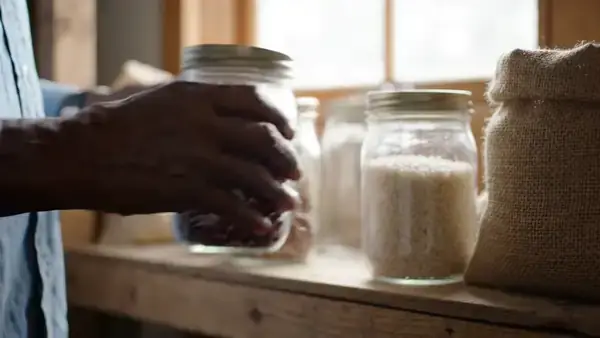
Three Shelves, and a Bag That Asked for All of Them
Let me explain the shelves, because the rest of this page hangs on them.
The top shelf is plain food.
A tin of cocoa, a sack of oats, a jar of coffee beans.
The label on these is a Nutrition Facts panel, and the reason you buy them is that you eat them.
The middle shelf is fortified food.
A box of breakfast flakes with a column of vitamins down the side.
The food is the point, and the vitamins ride along.
The bottom shelf is supplements.
These carry a Supplement Facts panel, and the reason you buy them is the list on the back rather than the taste. [1]
Most things in a kitchen know which shelf they belong on.
A bag of flour does not pretend to be a bottle.
This bag is different.
It looks like cocoa powder, it goes into a cup of coffee, and its label is a Supplement Facts panel with six numbered lines.
That is why I could not simply put it away.
I had to take it apart.
Line by line, each ingredient went to the shelf where I would keep it if I bought it on its own.
Some lines landed on the top shelf with the groceries.
Some landed in the herb jars.
One landed squarely on the fortified shelf, next to the cereal.
And when every line had a home, I could finally see what the bag was: a small amount of several good foods, a small amount of two herbs, and a large amount of one vitamin.
Here is how each line got sorted.
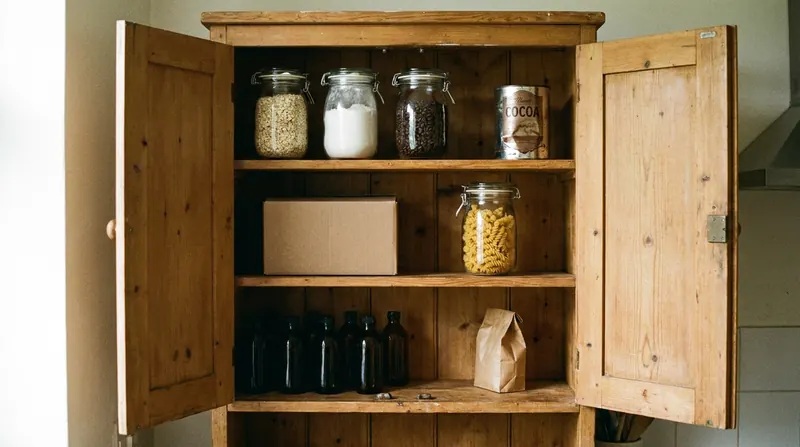
How I Read Anything Before It Goes on a Shelf
I ask four questions of every jar that comes through the door.
They are not clever questions.
One: what is it made of, in words I would find at the grocer?
If the answer is a word I would not find at the grocer, it goes to the bottom shelf, and it gets read more carefully.
Two: how much of each thing is in one spoon?
Not in the bag, and not in the serving the front of the bag talks about.
In the spoon I will actually use.
Three: what does the spoon go into?
A powder that goes into coffee is only half the cup, and the other half has a label too.
Four: what happens once the seal is broken?
Some things keep for years once opened, some keep a month, and some cannot go back to the store at all.
These four questions are the order of this page.
I will take them in turn, and I will tell you what I found at each one.
There is a fifth question I always ask last, and it is the one most people ask first.
Is it worth the room on the shelf?
I will answer that one at the end, once you have seen everything I saw.
One more word about how I read.
I do not read the front of a bag until I have read the back.
The front of a bag is written to be seen from six feet away in a store aisle.
The back is written to satisfy a regulation, and the regulation is the more honest author.
So in what follows, the back panel does the talking.
When the front says something different, I will say so, and I will say which one I believe.
Two Grams, in Kitchen Terms
The serving printed on the panel is three-quarters of a tablespoon.
The panel also gives it as a weight: two grams.
Two grams is not much by weight.
It is about half of what a level teaspoon of sugar weighs, and a good deal less than the spoonful of cocoa you might put in a cup of hot milk.
The bag holds thirty of those servings.
Thirty times two grams is sixty grams, a little over two ounces of powder.
In pantry terms, that is a small bag.
It sits in the palm of one hand.
The panel lists five calories a serving and two grams of carbohydrate.
In other words, the whole scoop counts as a carbohydrate, which is what you would expect from a powder made of dried mushrooms, cocoa and fruit.
It does not add much to a cup, then, in the way that sugar or cream would.
Five calories is less than a splash of milk.
The label says what to do with it plainly: "Add 1 scoop to your coffee, tea or smoothie."
It adds one more line underneath: "Try in baked goods too!"
I will come back to the baking suggestion, because the label gives an instruction without telling you what an oven does to the extracts in it.
For now, hold one picture in your mind.
Two grams of tan powder, a little less than a teaspoon, dropped into a cup.
Everything on the rest of this page is about how that two grams is divided up.
Because two grams, divided six ways, becomes small very quickly.
Here is the division, as the panel prints it.
Lion's mane extract, from the fruiting body: 500 milligrams.
Cacao powder, from the seed: 300 milligrams.
Cordyceps extract, from the fruiting body: 250 milligrams.
Rhodiola extract, from the root: 250 milligrams.
Bacopa extract, from the leaf: 200 milligrams.
Vitamin B12: 500 micrograms, which is half of one milligram.
Blueberry powder: listed under "other ingredients," with no amount.
Add up the numbered lines and you get roughly one and a half grams.
The remaining half gram or so is not given a number, and the only other thing the panel names is the blueberry.
I am not accusing the bag of anything there.
Serving weights on labels are rounded, and fruit powder has to weigh something.
But it does mean that the one ingredient the front of the bag pictures most cheerfully is the one whose amount you will never know.
Now to the shelves.
The Grocery Shelf: Cocoa and Blueberry
Two things on this panel I would buy at any supermarket.
They are the cacao and the blueberry, and they go on the top shelf with the other food.
The cacao line is 300 milligrams of cacao powder, from the seed.
That is about a seventh of the scoop.
In kitchen terms, 300 milligrams of cocoa is a pinch.
If you have ever made cocoa for a grandchild, you used many times that amount in a single mug.
What is it doing in the bag, then?
I think the honest answer is taste and color.
Dried mushroom extracts are earthy and faintly bitter on their own.
A little cocoa rounds that out and makes the whole powder look like something you would want to put in coffee.
The seller's page credits the cacao with "antioxidants."
That is a word I see on so many packages that I no longer know what it is meant to tell me.
I will not quote a cocoa study to you here.
I do not have one in my file that tested a pinch of this size for anything to do with focus, and I would rather leave the space empty than fill it with something that does not match.
The blueberry is harder to weigh.
The panel lists "organic blueberry powder" as an other ingredient, and gives it no number at all.
There is one blueberry trial in my reference file, and it is worth describing because it shows what a real amount looks like.
In a twelve-week study of 26 healthy older adults, averaging 68 years old, a daily blueberry concentrate supplying 387 milligrams of anthocyanidins, the colored compounds in the fruit, was tied to more blood flow in parts of the brain on a scan and a borderline result on one working-memory test. [2]
That study measured the colored compounds, not the fruit.
The bag does not say how much of those compounds is in its blueberry powder, or how much blueberry powder there is.
So I cannot tell you whether the blueberry here is closer to that trial or to a single berry.
And a small study with a borderline memory result is not a promise, even at the full amount.
I include it so you know what the word "blueberry" on a front panel would need to mean before it meant anything.
If you like blueberries, the top shelf has a better answer.
A handful of the fruit in your oatmeal is a food, and you will know exactly how much of it you ate.
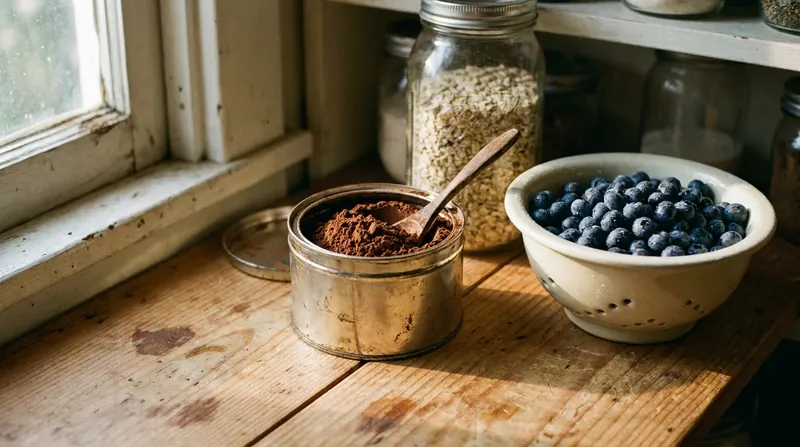
So, two ingredients on the top shelf.
Both are real foods, both are in the bag in small amounts, and one of them has no amount at all.
That is the grocery portion of the scoop.
It is pleasant, it is honest food, and it is not where any of the bag's promises could come from.

An Extract Is the Vanilla Bottle, Not the Bean
Before I walk the mushrooms to their shelf, one word needs explaining, because four of the six lines on this panel use it.
The word is extract.
Every pantry already holds the best lesson in extracts I know.
It is the small brown bottle of vanilla extract beside the baking soda.
A teaspoon of vanilla extract is not a teaspoon of vanilla beans.
It is what the beans left behind in a liquid after they soaked in it for a long time.
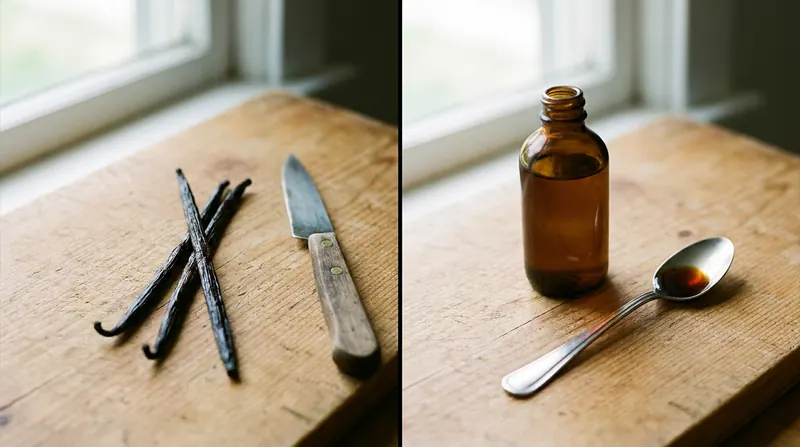
Nobody would read "one teaspoon of vanilla" on a recipe and reach for a teaspoon of whole beans.
The two are different things, measured in different ways, and one stands in for some unknown amount of the other.
The extracts in this bag work the same way, with one difference: they have been dried into a powder.
A plant or a mushroom is soaked in water, or in alcohol, or in both.
The liquid is then dried down, and the powder that remains is the extract.
Depending on how much plant went in and how much powder came out, a gram of extract can stand for several grams of the original, or for very little.
That ratio is the single most important number for any extract, and the panel on this bag does not print it for any of the four.
So when you read "500 milligrams of lion's mane extract," read it the way you would read "one teaspoon of vanilla extract."
It is a measure of the powder in the scoop, not a measure of the mushroom that went into it.
Four of the six lines on this panel are vanilla bottles, not beans.
I do not say that to fault the bag.
Many labels in this category print extracts without ratios, and many trials were run on extracts too.
But it means the honest comparison is always the one on the label, powder against powder.
And it means that whenever the front of a bag talks about how much mushroom you are getting, you should ask how that was counted.
The Mushroom Shelf: Lion's Mane and Cordyceps
The next two lines are mushrooms, and here my shelves get complicated.
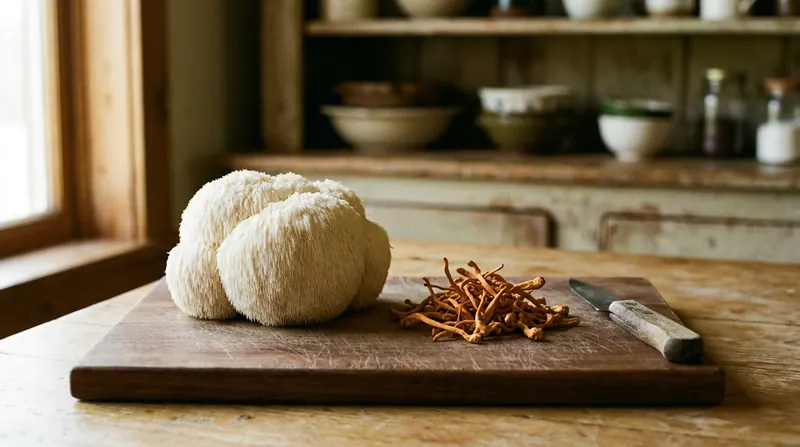
Lion's mane is a food.
In some markets you can buy it fresh, a white shaggy knot of a mushroom that cooks down like crab meat in a pan of butter.
Cordyceps militaris is also grown and eaten, a thin orange mushroom sold dried in some Asian grocers.
But neither of them is in this bag as a food.
Both are listed as extracts of the fruiting body, which is the part of the mushroom you see above the ground.
And as the vanilla bottle taught us, an extract is not the mushroom, and this panel does not say how concentrated either one is.
So the mushrooms move from the top shelf to the bottom one.
The lion's mane line is 500 milligrams of extract.
It is the largest single line in the scoop, a quarter of the whole two grams.
The trial most often quoted for lion's mane in adults my age is a small Japanese study.
Thirty-one healthy adults over 50 took a lion's mane fruiting-body preparation or a placebo for twelve weeks, and the lion's mane group scored higher on a standard mental-status test. [3]
The amount used in that trial was 3.2 grams a day.
That is more than six times the lion's mane line in this scoop, and more than one and a half times the weight of the entire scoop.
Now, in fairness to the bag, the trial used a whole-mushroom preparation and this bag uses an extract.
If the extract were very concentrated, 500 milligrams of it could stand for more than 500 milligrams of mushroom.
But the bag does not print that ratio.
And when a label does not print a number, I do not invent one on its behalf.
The only comparison I can make honestly is the one on the label: 500 milligrams against 3.2 grams.
There is one other lion's mane study in my file.
In 41 healthy adults aged 18 to 45, a single 1.8-gram dose was tied to faster performance on one attention task an hour later, while four weeks of daily use showed only a trend that did not reach significance. [4]
Young adults, a bigger dose, a single morning.
It is not a study of a man my age with a two-gram scoop in his coffee.
The cordyceps line is 250 milligrams of extract.
The seller's page credits it with "energy and endurance."
I looked, and my reference file holds no trial of cordyceps and memory or focus in adults that I could put beside this line.
So I will not borrow the seller's phrase, and I will not replace it with one of my own.
What I can tell you is what the line is.
It is an eighth of the scoop, from a mushroom that is also a food, in a form that is not.
Put the two mushrooms together and you have 750 milligrams, three-eighths of the scoop.
That is the heart of the bag, and it is the part the name on the front is built around.
It is also the part where the label gives the fewest facts you would need to compare it with anything.

The Herb Jar Shelf: Bacopa and Rhodiola
The next two lines would never be in my grocer's.
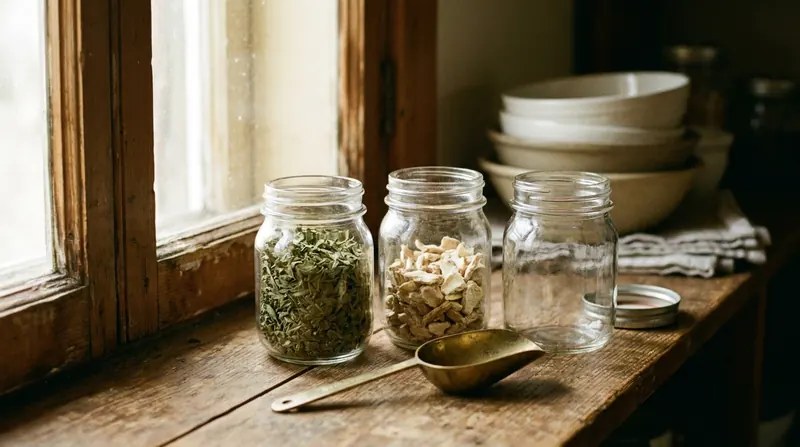
They are bacopa and rhodiola, and in my house they would go in the small glass jars on the bottom shelf, the ones I keep for things that are not food.
Bacopa is a small creeping plant with thick leaves, used for centuries in India.
Rhodiola is a root from cold mountain country in northern Europe and Asia.
Neither one is something you cook with.
Both are here as extracts, from the leaf and from the root.
The bacopa line is 200 milligrams.
Bacopa is one of the few plants in this whole category with several proper trials behind it, so it is worth reading carefully.
In one trial, 54 healthy adults aged 65 and older took 300 milligrams a day of a standardized bacopa extract or a placebo for twelve weeks.
The bacopa group did better at recalling words after a delay and at a task of ignoring distracting information, but not on the other measures, and the most common side effect was an upset stomach. [5]
In a second trial, 98 healthy adults over 55 took 300 milligrams a day for twelve weeks.
The bacopa group did better on learning and recalling words, the other measures did not differ, and the extract caused more stomach complaints than the placebo. [6]
A review that pooled nine trials of standardized extracts, each lasting at least twelve weeks, found faster scores on two measures of attention speed, and its authors asked for a large, well-designed trial. [7]
All three used 300 milligrams a day, for twelve weeks or longer.
The bag has 200 milligrams, two-thirds of that amount.
And it does not say whether its extract is standardized the way those trial extracts were, which is to say, measured for a set amount of the plant's active compounds.
Two-thirds of a dose, of an extract that may or may not match, is not the trial.
It is a smaller cousin of the trial.
The rhodiola line is 250 milligrams, from the root.
The seller's page credits it with "productivity and creativity."
The rhodiola trial in my file is an unusual one.
Fifty-six healthy young clinicians working hospital night shifts took one tablet a day of a standardized rhodiola extract or a placebo, and during the first two weeks the rhodiola group did better on a set of tests that measure how tired minds perform. [8]
Young clinicians, not men my age.
Night shifts, not a kitchen morning.
A tablet whose milligram count my file does not record, so I cannot say how 250 milligrams compares.
It is a real study with a real result, and it tells you almost nothing about this scoop.
Two herbs, two extracts, two sets of trials that were bigger than the bag.
If you wanted to try bacopa the way the trials did, you would be looking for 300 milligrams of a standardized extract, taken every day for three months.
That is a bottle for the bottom shelf, not two hundred milligrams folded into a cocoa-colored powder.
The Fortified Shelf: Half a Milligram of B12
One line on this panel goes straight to the middle shelf, next to the cereal.
Vitamin B12, 500 micrograms, as cyanocobalamin.
The percentage beside it on the panel is 20,833 percent of the Daily Value.
That number looks like a misprint, but it is not.
The Daily Value for vitamin B12 is 2.4 micrograms, and 500 divided by 2.4 is a little over two hundred and eight times the daily figure. [1]
Cyanocobalamin is the same form of B12 that is sprayed onto breakfast cereals and added to fortified foods.
It is the most ordinary vitamin on the middle shelf.
So is 500 micrograms too much?
The federal Office of Dietary Supplements says vitamin B12 has no upper limit set, because it has so little potential to cause harm, even at large amounts. [9]
The same office notes that B12 added to supplements and fortified foods is already in the unbound form the body can absorb without the stomach having to separate it from food first. [9]
That is the honest case for a big B12 line: it costs little, it is well tolerated, and it is in a form that is easy to take up.
Here is the honest case against leaning on it.
A Cochrane review, the kind that gathers every trial it can find and weighs them together, looked at fourteen trials in nearly 28,000 adults whose thinking was healthy.
It concluded that B-vitamin supplements, B12 among them, probably have little or no effect on overall thinking, at any point up to five years. [10]
Little or no effect, in people who were not short of the vitamin to begin with.
If a man is short of B12, that is a different matter, and it is one a clinician can check with a blood test.
It is not something to guess at from a powder.
A blood test tells you whether you need the vitamin. A scoop cannot tell you anything.
So the B12 goes on the middle shelf, where it belongs, beside the cereal box that has been carrying it for years.
It is the easiest line on the panel to understand, and the one least likely to be the reason anybody buys the bag.
That box is the whole panel in five lines.
Read it twice before you read anything else about this bag, including the rest of this page.
You will notice that not one line in it matches its trial.
Every one is smaller, or shorter, or tested in different people, or not tested at all.
That does not make the bag dishonest.
The panel prints its amounts plainly, which is more than many labels in this category do.
It makes the bag a food-sized serving of several things that were studied at supplement sizes.
And that is the single most useful thing a pantry reader can know about it.
Now that every line has a shelf, it is worth putting the whole bag back on the counter and looking at it as a shopper would.
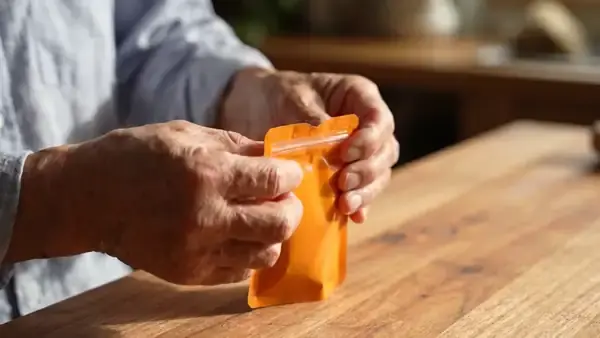
This is the pouch the six lines came out of, and what its front and back tell you before you open it.
The Words on the Front, Read Against the Back
The front of the bag and the seller's product page use a few phrases I would like to hold up against the panel, one at a time.
I am quoting them so you can see them beside the numbers, not because I agree with them.
"7 genius adaptogens."
The panel has six numbered lines and one blueberry in the other ingredients.
Cacao is a food, and vitamin B12 is a vitamin.
Neither one is what anyone means by an adaptogen, a word usually kept for plants like rhodiola that are said to help the body handle strain.
Take those two away and five names remain, and one of them is a berry.
The number seven is a front-of-bag number.
"High dose."
The lion's mane line is 500 milligrams against the 3.2 grams of its best-known trial. [3]
The bacopa line is two-thirds of the trial dose. [6]
I would not call either of those high.
"Shown to increase focus, productivity, and concentration."
The product page does not name a trial of this blend.
There may be studies of some of the ingredients, as you have seen, at other amounts and in other people.
But "shown to" is a claim about this powder, and I could not find the showing.
Those are the three phrases I would cross out on the front of the bag with a pencil.

There are others on the seller's page that I will not repeat at all, because they are not about the panel and they promise something no scoop should promise.
I do not mind a bit of cheer on a package.
The cocoa tin on my top shelf calls itself "rich" and "velvety," and I let it.
But a tin of cocoa is not claiming to sharpen anyone's mind.
When the front of a bag makes that kind of claim, the back has to carry it, and here it cannot.
The Word "Organic," Read the Way I Read It on Flour
The seller calls the blend organic, and the panel marks every plant line as organic too.
I buy organic flour and organic oats, so I know what that word means on my top shelf.
It is a word about how a thing was grown and handled.
It says nothing about what the thing does once you eat it.
Organic lion's mane is lion's mane grown under the organic rules.
It is not a stronger lion's mane, and the amount on the panel is the same 500 milligrams either way.
I am glad the bag is organic, in the same way I am glad my oats are.
But I would not let the word do any of the reading for me.
Organic tells you how it was grown. The panel tells you how much is in the scoop.
The same goes for "no fillers, grains or carriers," a line the seller uses about its lion's mane.
It is a fair point in a category where some powders are padded with the grain the mushroom grew on.
But the absence of a filler is not the presence of an amount.
The scoop still holds 500 milligrams of lion's mane extract, and that is the number to carry to the comparison.
What the Scoop Lands In
The third question on my list is what the spoon goes into.
For this bag the answer is usually coffee.
The front of the bag says the powder has no caffeine, and on the panel I see nothing that would add any.
That is true of the powder.
It is not true of the cup.
A 12-ounce cup of brewed coffee holds somewhere between 113 and 247 milligrams of caffeine, according to the Food and Drug Administration. [11]
The same agency cites 400 milligrams a day, about two to three of those cups, as an amount not generally tied to negative effects in most healthy adults. [11]
So when you stir a scoop of this into your morning coffee, the cup still has all the caffeine it had before.
The powder does not take any away and does not add any.
That matters for a simple reason.
If you drink this blend in coffee and feel more awake, the coffee may be doing the work.
Caffeine is the best-known thing in the whole kitchen for a feeling of alertness, and you were already drinking it.
A man could spend a month crediting a scoop for what his cup had been doing for forty years.
The only fair test of the scoop is the same cup, with and without it.
The label also allows tea or a smoothie.
Tea has its own caffeine unless it is herbal, and a smoothie has none unless you add some.
If you want to know what the powder does on its own, a smoothie or a cup of herbal tea is the cleaner test.
It will also tell you what the powder tastes like without coffee standing in front of it.
Too much caffeine can bring a faster heartbeat, jitters, an upset stomach, headaches and a restless night, the agency says, and some people are more sensitive than others. [11]
Nothing in this bag changes that, in either direction.
Now to the baking suggestion on the label: "Try in baked goods too!"
The label gives no oven temperature, no amount per loaf, and no word about what heat does to the extracts in the bag.
I have no study in my file that tells me either.
So I would keep it in the cup.
Not because baking is harmful, but because once it is in a muffin, you no longer know how much you ate, and the whole point of reading a panel is to know.

Thirty Mornings to a Bag, and Eighty-Four in a Trial
Every jar in my pantry has a lifespan, and I like to know it before I open the lid.
With this bag, the lifespan is easy to work out.
One scoop a day, thirty scoops to the bag: thirty mornings.
A bag opened on the first of the month is empty by the end of it.
Now set that beside the trials.
The lion's mane study ran twelve weeks. [3]
The bacopa trials ran twelve weeks. [5]
Twelve weeks is eighty-four days.
Eighty-four days is nearly three bags of this powder.
To copy the calendar of those trials, you would buy three bags. You still would not be copying the dose.
That is the pantry arithmetic nobody writes on the front of a bag.
A month is long enough to find out whether you like the taste.
It is not long enough to match the length of any trial in this page's reference list, except the two-week rhodiola study in young clinicians, and that one was a different amount in different people. [8]
The seller offers packs of one to four bags.
I understand the appeal of four; you pay less per bag, and a pantry man likes a full shelf.
But four bags is four months of a powder you have not yet tasted.
And as you will see in the next section, once a bag is open it cannot go back.
Buy one bag, taste it, and then decide about the shelf.
One more thing about the thirty mornings.
They only work if you use one level scoop, not a heaped one.
A heaped scoop could easily be a third larger, and the bag would run out in three weeks instead of four.
If you decide to try it, level the scoop with a knife, the way you would for a recipe.
That way the bag lasts as long as the label says, and every morning's cup is the same as the last.
You cannot judge a thing that changes every day.
A Broken Seal Is a Final Sale
My fourth question is what happens once the seal is broken.
For this bag, the answer is written plainly in the seller's return policy, and I want to give it to you plainly too.
The seller accepts returns within 45 days of purchase, and only for unopened bags with the seal intact.
The policy's own words are these: "Open food items and/or supplements that have been opened or have a broken seal cannot be returned."
There are three more conditions.
You have to email the company before sending anything back, at info@foursigmafoods.com, and items returned without that email first will not be refunded.
The refund is the price of the item minus a 3 percent processing fee and minus the original shipping cost.
And you pay to ship the bag back.
In short: if you open the bag and do not like it, it is yours.
I do not say that to scold the seller.
Plenty of food companies take back nothing that has been opened, and I understand why a company that sells food cannot resell an opened pouch.
But it changes how a sensible man buys.
It means the first bag is the cost of finding out, and it should be one bag, not four.
It also means the flavor is a gamble you cannot undo.
The seller describes the taste as "light" and "smooth," and I have no reason to doubt that some people find it so, but taste is personal, and the policy does not care what yours is.
In my pantry, a broken seal has always meant the thing is mine. This bag follows the same rule.
One more small point about addresses, because I check them for every seller.
The seller's terms list an office at 1450 2nd Street, Suite 210, in Santa Monica, California.
Its contact page prints a different address, in Wilmington, Delaware, which is the kind of registered address many companies keep for legal filings.
Both are real kinds of address, and there is nothing strange in a company having two.
But if you ever need to send a letter, the Santa Monica office is the one the terms give.
Customer support is listed at support@foursigmatic.com and by phone at (855) 400-8584.
Returns go to the other email, info@foursigmafoods.com, first.
Write both down before you open the bag, the way you would keep a receipt for anything you might take back.
Although, as we have seen, the moment you open it, you will not need the returns address.
The Rest of the Pantry, Which Has Better Evidence
I have spent a long time on one small bag.
Before I give my verdict on it, I want to spend a little time on the rest of the pantry, because the rest of the pantry has the stronger case.
Start with the tap.
In a German study of 1,111 adults aged 60 to 89, the third who were measurably short of water showed a steeper slide on a test of processing speed over time than the rest. [12]
A review of eighteen studies in more than 33,000 adults aged 60 and over found only thin evidence linking a lack of water to poorer thinking, but it found it. [13]
These are observations, not trials, and they do not prove cause.
But a glass of water costs nothing, and it is the first thing I would put on the list before any powder.

Then the food on the top shelf.
In a three-year trial of 604 older adults, one group followed the MIND diet, built on vegetables, berries, beans, whole grains and olive oil, and another followed a control diet with a mild cut in calories. [14]
Both groups improved on tests of thinking over the three years.
And they improved about equally. [14]
I find that result more encouraging than disappointing.
It suggests that the act of eating with care, whatever the exact list, may matter more than any single food on it.
And then the packaged food on the shelves.
In a Brazilian study that followed 10,775 adults for about eight years, those who ate more ultraprocessed food, the packaged snacks and ready meals, showed a faster slide on tests of thinking than those who ate the least. [15]
Again, an observation, and a modest one in absolute terms.
But it points the same way as everything else on this list: toward the plain food on the top shelf and away from the brightly colored boxes.
None of these is a product. All of them are in your kitchen already.
That is the part of this story I find most useful to a man my age.
The best-supported things are the cheapest ones, and they are already in the cupboard.

I do not say this to talk you out of the bag.
If you decide to buy it, drink it in a glass of water's worth of good habits, and you will at least know what the bag is sitting on.
I say it because a scoop of powder is the easiest part of the whole picture to buy, and the easiest to overrate.
The rest takes a little more effort, and that is why it tends to work.
Why No Customer Is Quoted on This Page
Usually, when I write about a product, I look for what real buyers have said about it.
I looked for this one too.
The seller's product page shows a review widget with a count of 5,352 reviews and a buyer mark beside each one.
That number is large, and it looks like it belongs to the bag.
It does not.
When I read through the reviews that loaded, they were about the company's other products: coffees, a probiotic, other blends.
None of the ones I could read named this powder.
The count is the whole store's count, placed on this bag's page.
So I have no customer words about this bag that I can check, and I will not borrow words about other products.
I do not think the seller meant to mislead anyone.
Store-wide review widgets are common, and they are cheap to set up.
But a pantry man reads a count the way he reads a weight: he wants to know what it is a count of.
And this one is a count of something else.
If the bag ever gets reviews of its own, they will tell you more than anything I could say about taste.
Until then, the panel is the only witness, and I have let it speak for itself.

Who Might Give It a Place on the Shelf
After all that, you may think I am against the bag.
I am not.
There is a man for whom this bag makes sense, and I can describe him fairly well.
He already drinks coffee every morning, and he is going to keep drinking it.
He likes the idea of stirring a little mushroom and cocoa into a cup he makes anyway, the way some men add cinnamon.
He has read this far, and he knows the amounts are smaller than the trials.
He is not buying a trial; he is buying a habit, and he is honest with himself about the difference.
He is willing to buy one bag and live with it if he does not like the taste.
Thirty mornings is the cost of finding out, and he can afford it without minding.
For that man, the bag is a reasonable small experiment, as long as he keeps his expectations the size of the scoop.
There is also a man for whom I would leave it on the store shelf.
If you take anything daily from a pharmacy counter, ask the pharmacist before you add a new powder with four plant extracts in it.
That is a short conversation, and it is the one conversation I would never skip.
If your stomach is easily upset, remember that the bacopa trials recorded more stomach complaints than the placebo did. [6]
The amount here is smaller, but it is not nothing.
If you are hoping for a change you can feel in a week, this is not the bag, and I do not know of any bag that is.
And if you want bacopa or lion's mane at the amounts the trials used, this blend will not get you there.
You would be looking for a single-ingredient product with the trial's amount printed on the panel, and you would still want to speak with a clinician first.

If It Earns a Month on Your Shelf
Suppose you have decided to try one bag.
Here is how I would run the month, the same way I would test any new thing in the kitchen.
Write the date on the bag the day you open it.
It is what I do with every jar in my pantry, and it takes a second with a pencil.
Use one level scoop, in the same cup, at the same time each morning.
If the cup changes every day, you will never know what the scoop did.
Keep a short line in a notebook each evening.
Not how you feel in general, but one concrete thing: did you finish the crossword, did you remember where you left the keys, did the afternoon drag.
Change nothing else if you can help it.
Not a new walk, not a new diet, not a second new product; one change at a time is the only way to read the result.
At the end of thirty mornings, read the notebook.
If you cannot see a difference in your own handwriting, you have your answer, and it cost you one bag.
A month, a notebook and a pencil. It is the cheapest honest test I know.
And if you do see a difference, remember the coffee.
Try a week of the same cup without the scoop before you order more, and see whether the difference stays.

That last week is the part most people skip.
It is also the only part that tells you whether it was the powder.
What I Would Not Expect From the Bag
Here, in one list, are the things this bag will not do, on the evidence I could find.
- It will not give you the lion's mane amount of the twelve-week trial, which was more than six times its line.
- It will not give you the bacopa amount of the trials, which was half again as much.
- It will not change the caffeine in your cup, in either direction.
- It will not tell you whether you are short of vitamin B12; only a blood test can do that.
- It will not come back to the seller once you have opened it.
- It will not stand in for water, good food, a walk or a conversation with a clinician.
And here is what it does do, fairly.
- It gives you a food-sized serving of lion's mane, cordyceps, cacao, bacopa, rhodiola and blueberry in one scoop.
- It prints the amount of every numbered line, which many blends in this category do not.
- It adds five calories and no caffeine of its own to your cup.
- It supplies far more than a day's vitamin B12, in the form used in fortified foods.
- It lasts thirty mornings at one level scoop.
That is a modest list.
I think a modest list is what an honest bag of this size should carry.
Where the Bag Comes From
Four Sigma Foods, Inc. sells the blend under the Four Sigmatic name from its own shop in the United States.
The seller runs a separate shop for international orders.
The company makes other things too: mushroom coffees, other blends, and a capsule product with a similar name that is a different formula.
This page is only about the powder in the orange bag, and if you order, check that the product name reads Focus Mushroom Blend.
I have shown you every line on the panel and every condition on the return.
If you have read this far, you know as much about the bag as I do.
Every ingredient in this bag, with the amount on the panel, what it is, and the cautions that go with it, is written out in full in the ingredient guide linked at the foot of this page.
That guide also carries the references in full and the disclosures this page is required to make.
One bag for the pantry, from the company that blends it
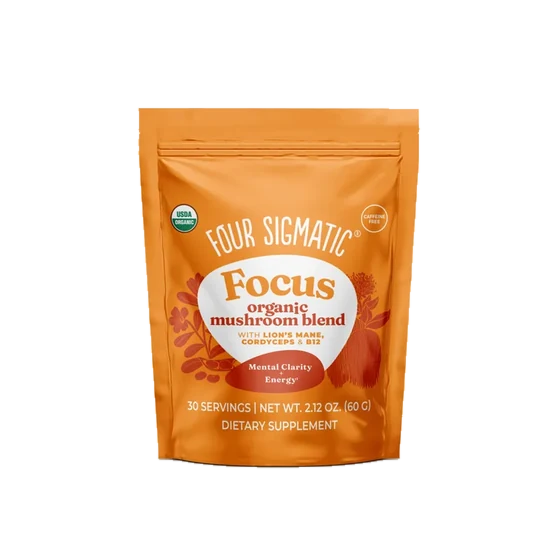
Three-quarters of a tablespoon of mushroom, cacao and herb powder stirred into your coffee, with no caffeine of its own, from a company in Santa Monica.
SEE THE ORANGE BAG AT FOUR SIGMATICSold by Four Sigma Foods, Inc., Santa Monica, California · 30 level scoops of 2 grams · no caffeine in the powder · returns within 45 days for unopened bags only, after writing to the seller first
What neighbors ask when they see it on my shelf
Is it food or a supplement?
The bag carries a Supplement Facts panel, so it is sold as a dietary supplement, even though most of what is in it comes from foods.
Does it have caffeine?
The powder has none of its own. The coffee you stir it into keeps all of its caffeine.
How long does a bag last?
Thirty mornings at one level scoop of about three-quarters of a tablespoon.
Can I send it back if I don't like the taste?
No. The seller takes back only unopened bags with the seal intact, within 45 days, after an email first.
Is the lion's mane the same amount as in the study?
No. The bag has 500 milligrams of extract; the twelve-week trial used 3.2 grams a day of a whole preparation.
Is 500 micrograms of B12 too much?
There is no upper limit set for B12, because it has very little potential to cause harm. If you are unsure whether you need it, a clinician can check with a blood test.
Can I bake with it?
The label suggests it, but it gives no amounts and says nothing about heat. I would keep it in the cup, where you know how much you had.
Should I ask anyone before I try it?
If you take anything daily, ask your pharmacist first. It is a short conversation.
The Shelf Card, in Short
If you tape one card to the inside of the pantry door, make it this one.
- Two grams a scoop, thirty scoops a bag, five calories, no caffeine in the powder.
- Top shelf: 300 mg of cacao and an unmeasured amount of blueberry powder.
- Mushroom shelf: 500 mg of lion's mane extract and 250 mg of cordyceps extract, with no concentration printed.
- Herb jars: 200 mg of bacopa and 250 mg of rhodiola, both smaller than their trials.
- Fortified shelf: 500 mcg of vitamin B12, about 208 times the daily figure, with no upper limit set.
- The cup: your coffee's caffeine is unchanged.
- The seal: once opened, it cannot be returned.
- The rest of the pantry: water, plain food and fewer packaged snacks carry the better evidence.
Is It Worth the Room on the Shelf?
That was the fifth question, and I promised to answer it last.
Here is my answer.
It is worth one bag's worth of room, for one month, for the right man, with his eyes open.
It is not a bottle for the bottom shelf in the way the trials were.
It is a food-sized scoop of several studied things, sold with a front panel that says more than the back panel can support.
If you like the idea of a little mushroom and cocoa in your morning coffee, and you are happy to test it honestly, it is a reasonable thing to try.
If you want the amounts from the studies, you will have to look elsewhere, and you will have to read those labels just as carefully.
Either way, read the back before the front. It has never let me down.
My brother-in-law, for the record, took the bag home.
He said he would write the date on it.
Thirty level scoops, sold by the people in Santa Monica
Three-quarters of a tablespoon of mushroom, cacao and herb powder stirred into your coffee, with no caffeine of its own, from a company in Santa Monica.
SEE THE ORANGE BAG AT FOUR SIGMATICFour Sigma Foods, Inc., 1450 2nd St, Suite 210, Santa Monica, California · (855) 400-8584 · one bag lasts thirty mornings · returns within 45 days, unopened bags only, less 3 percent and shipping
P.S. If you keep only one number from this page, keep this one: the lion's mane line is 500 milligrams, and the trial used 3,200.
P.P.S. And if you keep one rule, keep the pantry's: once the seal is broken, the bag is yours.